ExhibitionIVAM Centre Julio González

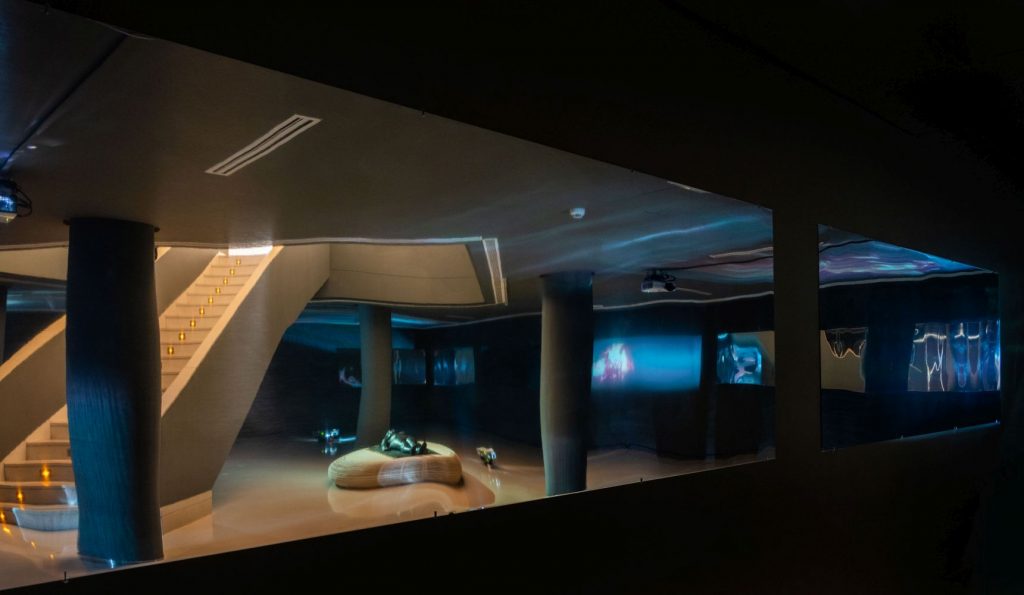
Lola Lasurt’s exhibition Cardiograma suggests various reflections on the recent past through a sculpture of a woman called “democracy” and two series of images projected on zinc plates or painted by the artist and arranged on each floor of the gallery.
Like an amateur historian, the artist recomposes various elements to construct a narrative with multiple meanings. The story has two beginnings. The first is a visit to the Museo del Gremi Artesà de Fallers, a museum in Valencia’s Ciutat Fallera district, and an encounter with a figure made for a Falla, possibly a ninot spared from the flames, called “democracy”. Made by José Azpeitia, perhaps in the early eighties, it is a life-size nude figure of a young woman lying face up with her eyes closed. The patina of dark paint that covers the fibreglass piece imitates the bronze finish of funerary sculptures. She appears to be dead, but her placid face invites us to think that perhaps she is only asleep. For the exhibition, the artist has collaborated with the school of the Grau Superior de Formació Professional d’Artista Faller i Construcció d’Escenografies, the guild of Falla artists, also based in Ciutat Fallera. The students have made a crochet cushion to support, hold, protect and care for the figure of “democracy”.

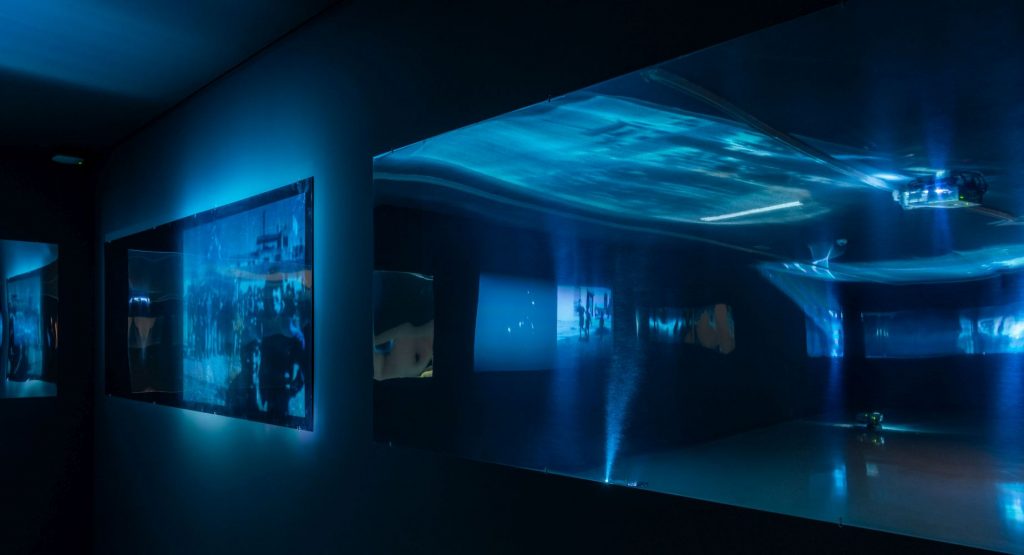
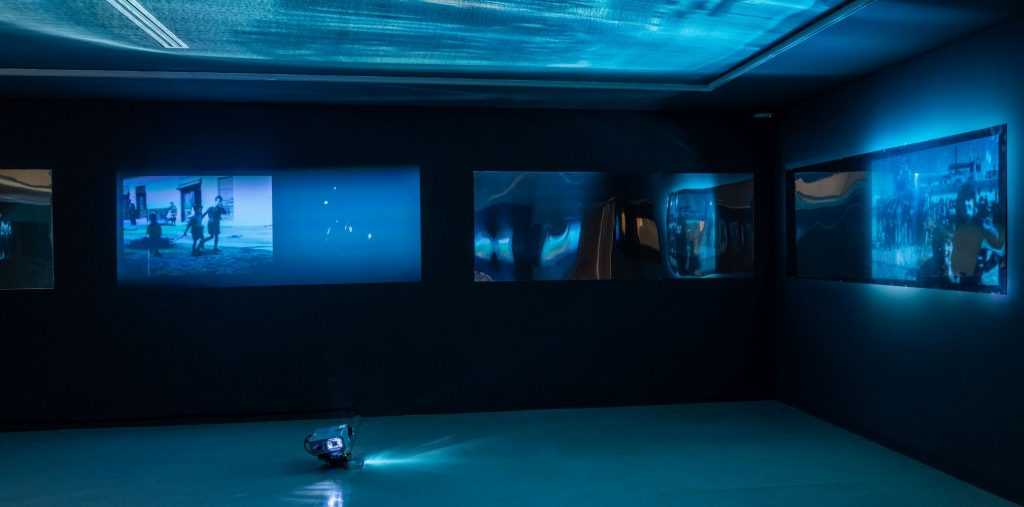
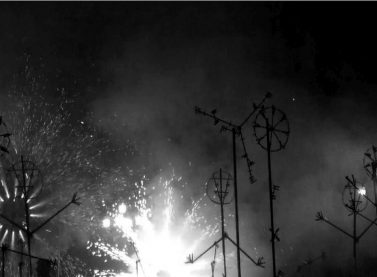
Projected onto zinc plates on the surrounding frieze are various images from family archives, made available by the Film Archive of the Institut Valencià de Cultura. Recorded between the 1950s and the 1970s, the images show different pyrotechnic displays like disparás, mascletás, cordás and santotomás. They represent a time before digitalisation, with analog images that in their turn show a primitive fire made with old pyrotechnic techniques. The artist has edited these images as an atonal score, producing a rhythm of bonfires and fireworks that the zinc plates will reactivate.
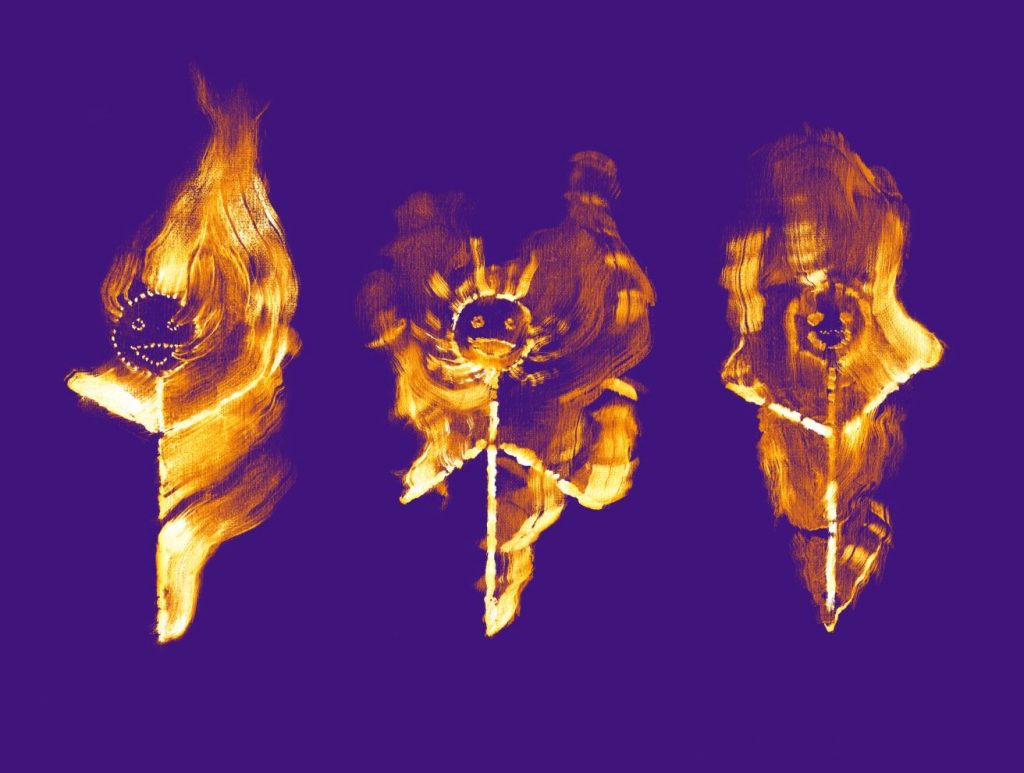
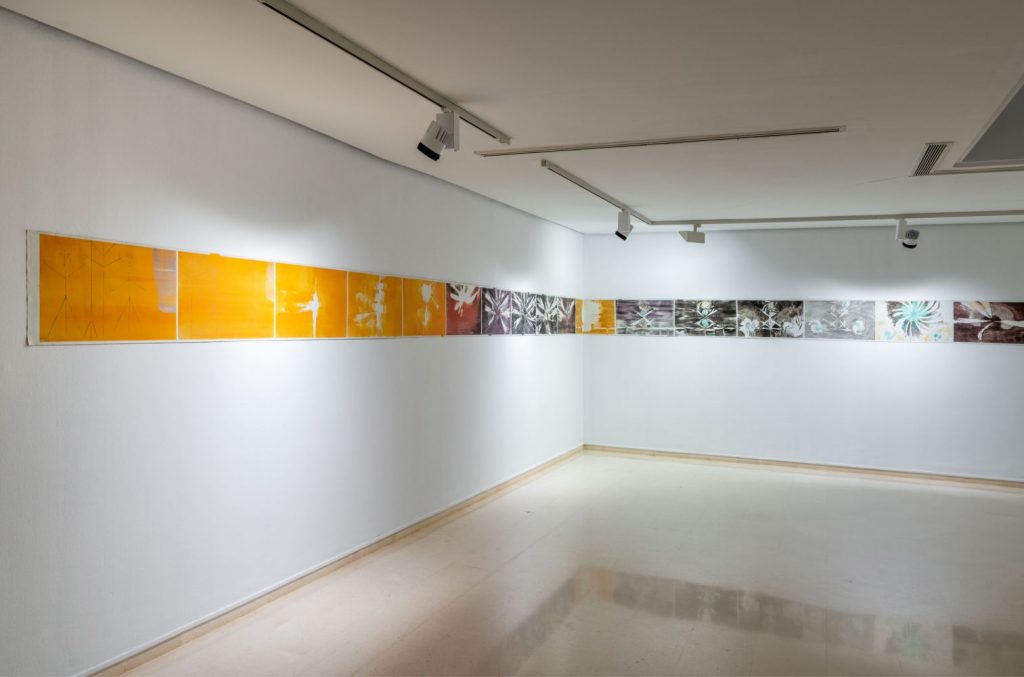
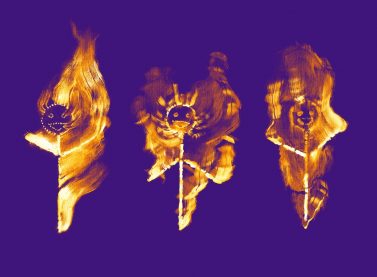
Another start to this story is developed on the upper floor. By means of a coloured frieze painted in oils, the artist mimetically produces a frame-by-frame representation of a video circulating on the internet that documents a pyrotechnic exhibition she was fortunate enough to witness. The display revived old-fashioned types of firework, like the Castell de Pals and the Roman candle, in Valencia’s Plaza de la Virgen during the July Fair of 2017. The frieze also relates to theories of atonal music, applied in this case to the timbre of colour.

The title of the exhibition, Cardiograma, refers to the notion of diagnosing the state of the system as personified in the timeless sculpture of “democracy”, preserved by the guild of Falla artists alongside the ninots it has saved from destruction. At the same time, we can also understand the fiesta of the Fallas itself as an exercise in collective diagnosis, doubly held in suspense this year by the pandemic, that responds annually to the socio-political issues of the moment.

In this exhibition, Lola Lasurt continues her investigations “out of time”, a mode of deferred thought that dodges around historical doctrine and uses painting to reorganise other tales of our past where images, objects and (in this case) popular festivals speak to us of a complex passage. With the artist, we wonder which point of democracy we have reached. What were its initial objectives? What were its aspirations? The figure of “democracy”, surrounded by “shooting” fireworks, tells us of a world in retreat that is revived by the artist, its image bouncing back into our present day.

Videos

MusicIVAM Centre Julio González

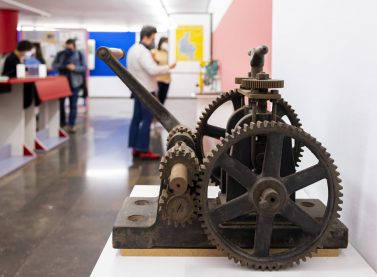
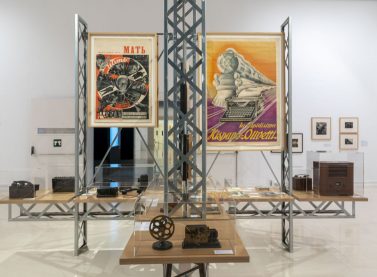
The exhibition Imaginarios Mecánicos y Técnicos en la Colección del IVAM brings together works by artists from the IVAM collection, who throughout the 20th century have been fascinated by the technical and technological advances of science and have directed their research and practices to the relationship between science and art from very different approaches: those interested in designing and building mechanisms, but also in creating imaginaries that reflect the spirit of the industrial and scientific culture that surrounds them, who reflect on the spirit, time, the body and memory, such as Alexander Calder, Germaine Krull Marcel Duchamp, Lászó Peri or Man Ray, creators who defend the dialogue between science and art such as Yturralde, Alfaro, Sempere, Elena Asins or Soledad Sevilla, or conceptual storytellers, such as Thomas Ruff, among others.

On the occasion of the opening of this exhibition and coinciding with the celebration of Women’s Day, we want to give visibility to the contributions made during this period by women and we do it through the figure of the composer Carmen Barradas, who despite being very close to avant-garde movements such as Vibrationism, Spanish Ultraism or Futurism’s machinist-music, was forgotten like so many other artists.

To this end, we have organized, in collaboration with Professor Miguel Molina-Alarcón, director of the Intermedia Creations Laboratory of the UPV and the pianist Patricia Pérez, the concert series CARMEN BARRADAS (1888-1963): Imaginarios mecánicos sonoros, with which we want to pay tribute to her by performing some of her most representative mechanistic compositions.

PROGRAM:

  • Campanero loco (Montevideo, 1934. Néffer Kröger’s review and transcript, 1971)*
  • Taller Mecánico (premiered in Barcelona, 1928)
  • Poema del reloj *
  • Canción del Trabajo (part II of Campana de Toledo. Madrid, 1924) *
  • Espera el coche (published in Revista de Casa América-Galicia, 1923)
  • El coche (nocturne)*
  • Nocturno en el taller *
  • Cajita de música (from Miniaturas, ca.1915)
  • Aserradero (Madrid, ca. 1921)
  • Fundición (Madrid, ca. 1922, published in Revista de Casa América-Galicia, 1923)
  • Fabricación (Madrid, 1922. published in Montevideo, 1939)

*Absolute premiere.

Performance:

Piano: Patricia Pérez Hernández

ExhibitionLibraryIVAM Centre Julio González

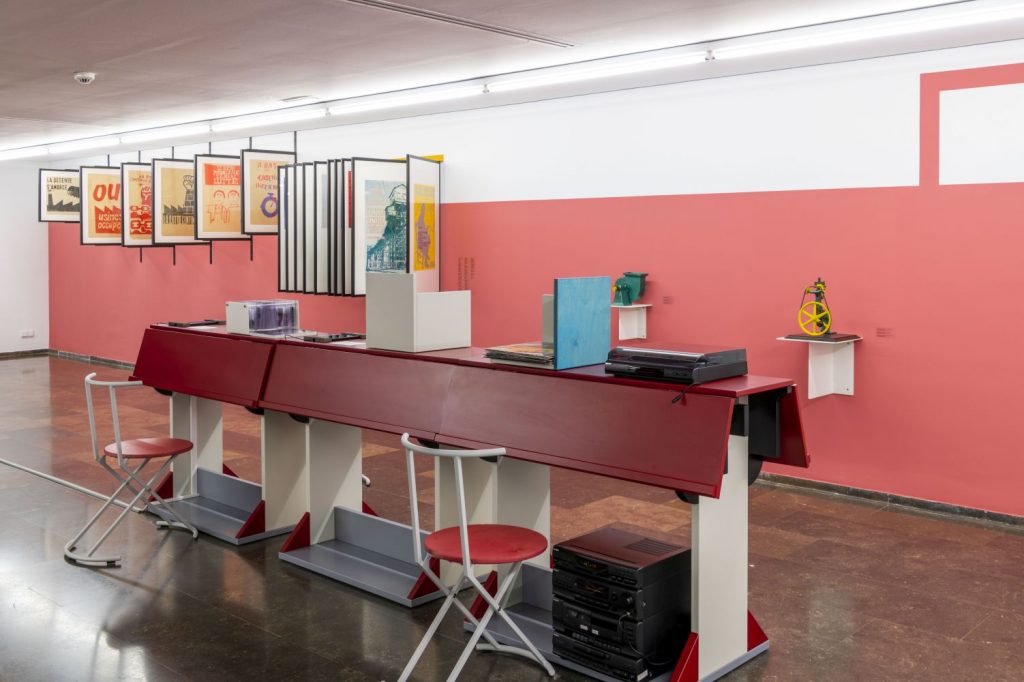
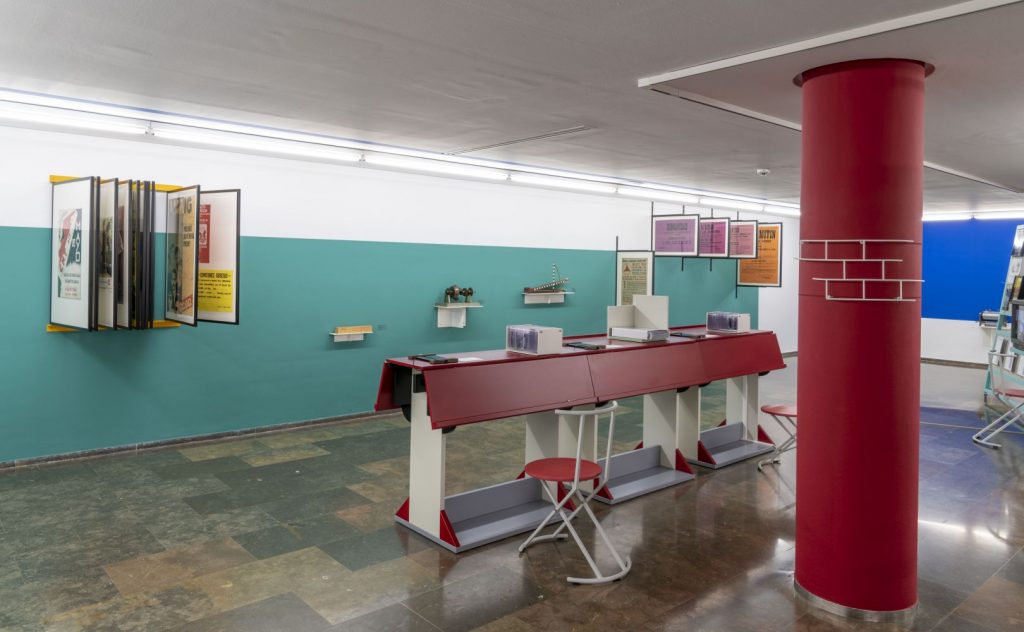
The documentary exhibition Apuntes sobre abstracción geométrica en España (Notes about geometric abstraction in Spain) tries to offer clues about the crossroads between art and technology; conceptual and formal basis of many artistic practices developed in Spain since the sixties.

The starting point of the exhibition is the Primera exposición conjunta de arte normativo español, organized by the Parpalló Group and shown at the Ateneo Mercantil de València in 1960. This historic exhibition showed the aesthetic opening of Spanish art towards other paths that did not have informalism as their main objective. The Antes del Arte collective, under the direction of Vicente Aguilera Cerni, proposed a questioning attitude towards aesthetic dynamics that were still very stiff and served as the beginning of practices where theory anticipated aesthetic results. Among the members of this group were Eusebio Sempere, Jordi Teixidor and José María Yturralde, leading figures in understanding the relationship between geometry, art and technology in the sixties and seventies.

Some of the members of the Antes del Arte collective, together with Elena Asins or Soledad Sevilla participated in the historic Computation Center at Madrid University, being an example of the wide range of Valencian artists in the first movements of Spanish geometric abstraction.

ConversationsIVAM Centre Julio González

Campaign for equality between women and men in the museum and in education. | #Portaldeigualdad

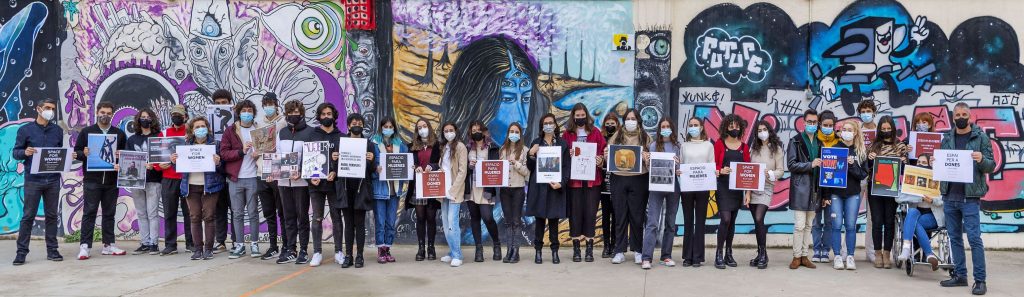
A conference of the feminist artist and curator Mau Monleón Prada, about the public art project #Portaldeigualdad that is developed within the IVAM PRODUEIX program in collaboration with various cultural associations working in Spain to achieve equality.

#Portaldeigualdad is a participative campaign promoted by Mau Monleón and artists, cultural agents and associations which calls for the inclusion of an Equality Portal in the webpages of museums and art centers. An Equality Portal is an innovative idea that allows museums to include a gender perspective in their webpages of all the information they handle and produce, so it is visible and available for all the public. This information should include their collections, exhibitions and other activities, as well as the management of their libraries, and other aspects related to each particular museum, at the same time taking on a prospective quality.

The #Portaldeigualdad project focuses its campaign on different participative actions, including a video campaign, a visual participative campaign and a discussion forum, among others.

Mau Monleón Pradas works in video, photography, text, installation, public art and transmedia. Her projects as an artist and curator focus on the public sphere, exploring themes like gender violence; work and education and architecture, among others.

Rehacer. Break Out of Your Shell

ExhibitionIVAM Centre Julio González

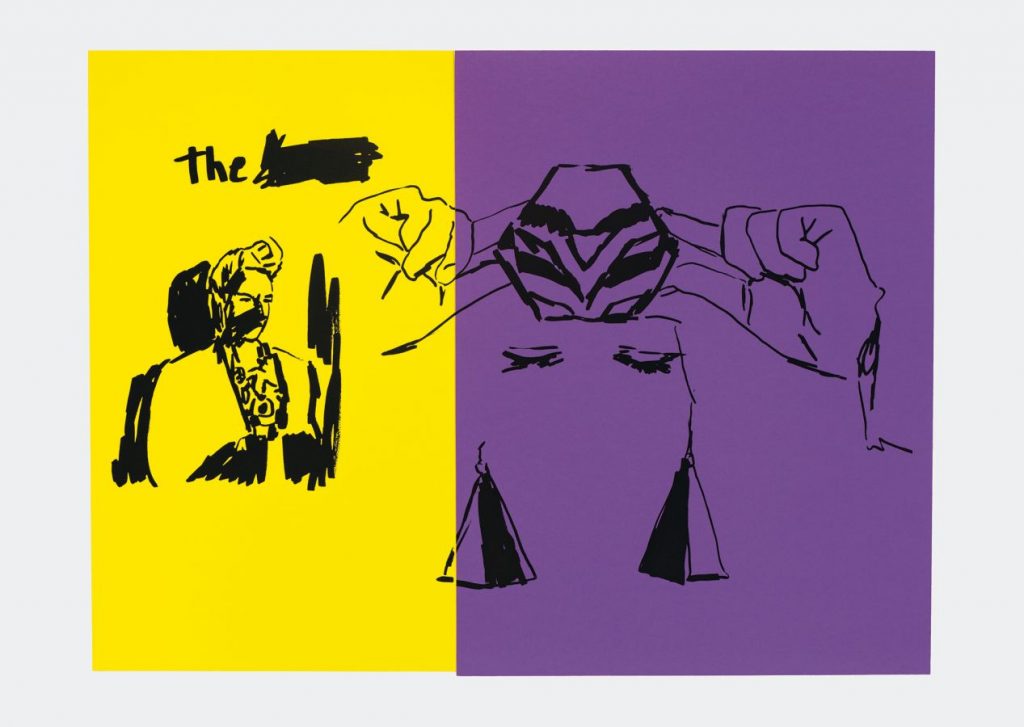
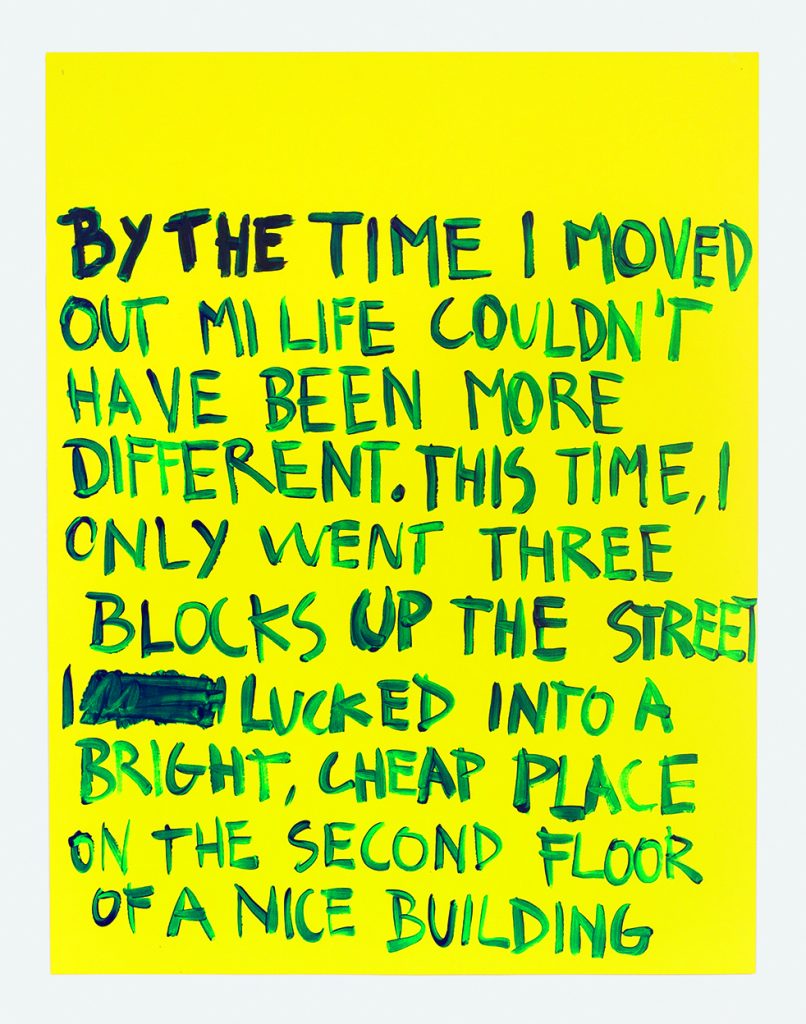
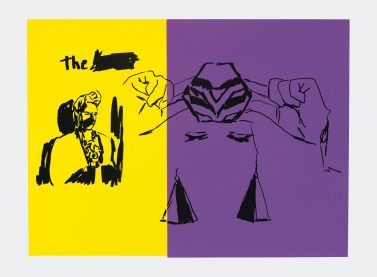
This project for IVAM by the artist Azucena Vieites (1967, Hernani) delves into the languages linked to a subcultural aesthetic and its forms of production, between low-fi (low-fidelity) artistic practice and the idea of editing. Vieites proposes a reflection on contemporary visual culture from resources such as multiplicity, fragment, appropriation or concealment and she questions the logic of classical narrative.

As its starting point, this project takes the realization of a workshop on feminist fanzine with students from the city of Valencia. Part of its development focuses on “remaking” a previous work by the artist called Break Out of Your Shell (2009).

The proposal will be installed in different transit spaces of the museum and will directly question the subjectivities that inhabit it.

Her work makes approaches to contemporary visual culture through graphic resources such as drawing or silkscreen printing. In 1994 she co-founded Erreakzioa-Reacción, an initiative to develop the project between art and feminism. Among her latest solo exhibitions are: Playing Across Papers, Sala Alcalá 31 (Madrid, 2020-2021); Hey Baby!, Box 27, Casal Solleric (Palma, 2018); Woollen Body, Carreras Múgica gallery (Bilbao, 2015); Tableau Vivant, Museo Nacional Centro de Arte Reina Sofía (Madrid, 2013), or Fundido encadenado-Break You Nice, MUSAC (León, 2012). She has been part of the 11th edition of the Berlin Biennale 2020. Her work can be found in the collections of Museo Reina Sofía, CA2M, Artium, CGAC, Basque Government, MUSAC, Juntas Generales de Gipuzkoa and Fundación Botín.

ConversationsIVAM Centre Julio González

On the occasion of the project’s presentation for IVAM titled Rehacer (Break Out of Your Shell) by Azucena Vieites, the artist herself and one of IVAM’s curators, Sandra Moros, will talk about the approaches and development of the proposal.

As its starting point, this project takes the realization of a workshop on feminist fanzine with students from the city of Valencia. Part of its development focuses on “remaking” a previous work by the artist called Break Out of Your Shell (2009).

Azucena Vieites (Hernani, 1967)

Her work makes approaches to contemporary visual culture through graphic resources such as drawing or silkscreen printing. In 1994 she co-founded Erreakzioa-Reacción, an initiative to develop the project between art and feminism. Among her latest solo exhibitions are: Playing Across Papers, Sala Alcalá 31 (Madrid, 2020-2021); Hey Baby!, Box 27, Casal Solleric (Palma, 2018); Woollen Body, Carreras Múgica gallery (Bilbao, 2015); Tableau Vivant, Museo Nacional Centro de Arte Reina Sofía (Madrid, 2013), or Fundido encadenado-Break You Nice, MUSAC (León, 2012). She has been part of the 11th edition of the Berlin Biennale 2020. Her work can be found in the collections of Museo Reina Sofía, CA2M, Artium, CGAC, Basque Government, MUSAC, Juntas Generales de Gipuzkoa and Fundación Botín.

Videos

Hathor

IVAM ProduceIVAM Centre Julio González

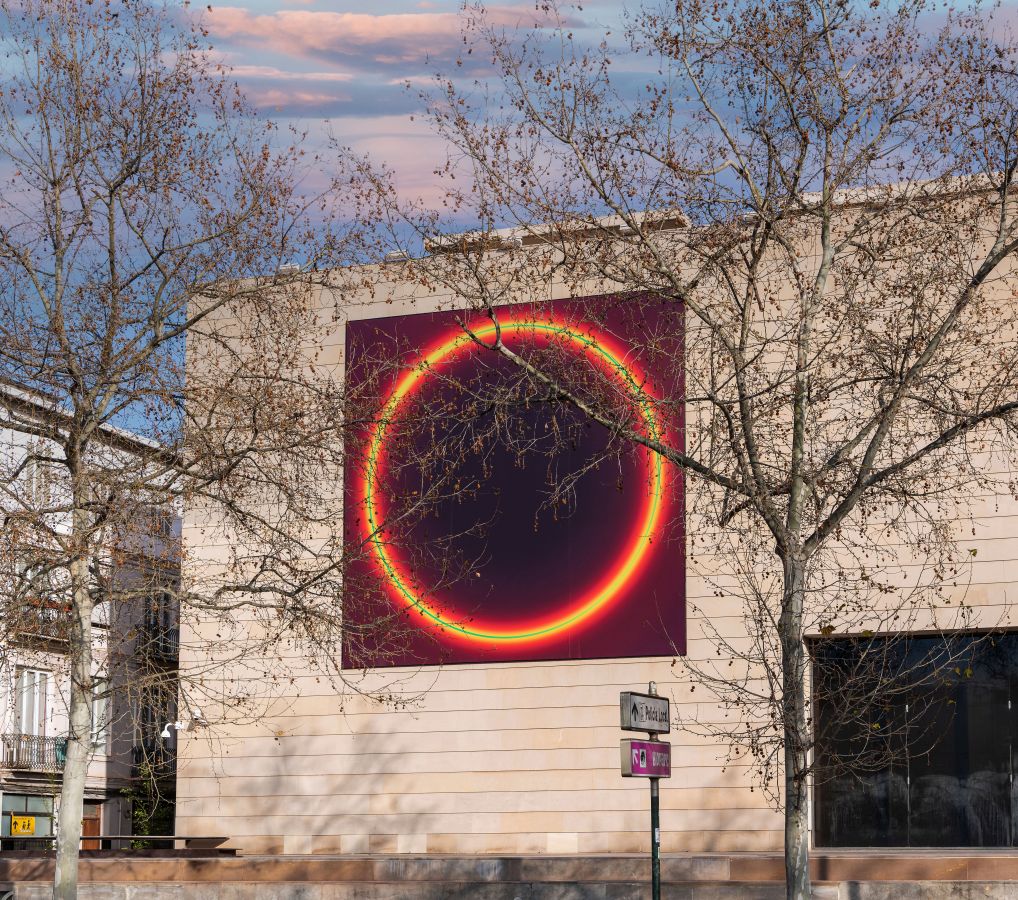
This work entitled Hathor, which takes its name from an Egyptian goddess, belongs to Enso, a pictorial series characterised by the representation of circular forms, which I have been working on since 2015. With infinite nuances, the circle and its three-dimensional extension, the sphere, are a part of nature and of every culture in which nature retains its magical transcendence. Both symbolise perfection and its effects, like the cosmic heavens or their cyclical movements.

The ancient Greeks drew a distinction between “figure”, that which is seen and perceived, and the invisible “form”, which is captured with the mind: the Platonic eidos, the idea, notion, space, genre, etc. In Greek, the term “idea” comes from the verb eidon, meaning “to see”. In western culture, pictorial form as an expressive artistic element has permitted us to attain what we call abstraction, understood as an absolutely logical mental development.

For a long time, I worked around the idea of wholeness and nothingness, dissolving geometric structures from earlier phases. I explored Zen thought on the basis of the maxim: “Form is emptiness, emptiness is form”, which perhaps leads us further. In its most emotive and organic sense, I regard this form, together with colour, as the essential condition for transcending entropy, which is akin to saying “flowing with life”. Fascinated by the painting characteristic of Zen Buddhism, and especially its vision of emptiness, I investigated the concept of enso (circle in Japanese) owing to the symbolism of infinity it projects and its goal of freeing the mind to reach the essential. It also implies a component of deliberate imperfection, almost a necessity, which makes change and transcendence possible.

Enso is a mode of illumination, a spiritual exercise, symbolising the universe, emptiness, infinity… My approach to this concept is subjective and relative, since I belong to western culture. From it I express myself, and through it I seek the mystic and sacred values that are common to all human beings and present in all cultures. With its immense simplicity, greater even than that of a haiku, the enso represents for me the imperfect perfection of the present moment.

José María Yturralde

Performance of the students of the Advanced Study Centre (Centre de Perfeccionament del Palau de Les Arts)

MusicIVAM Centre Julio González

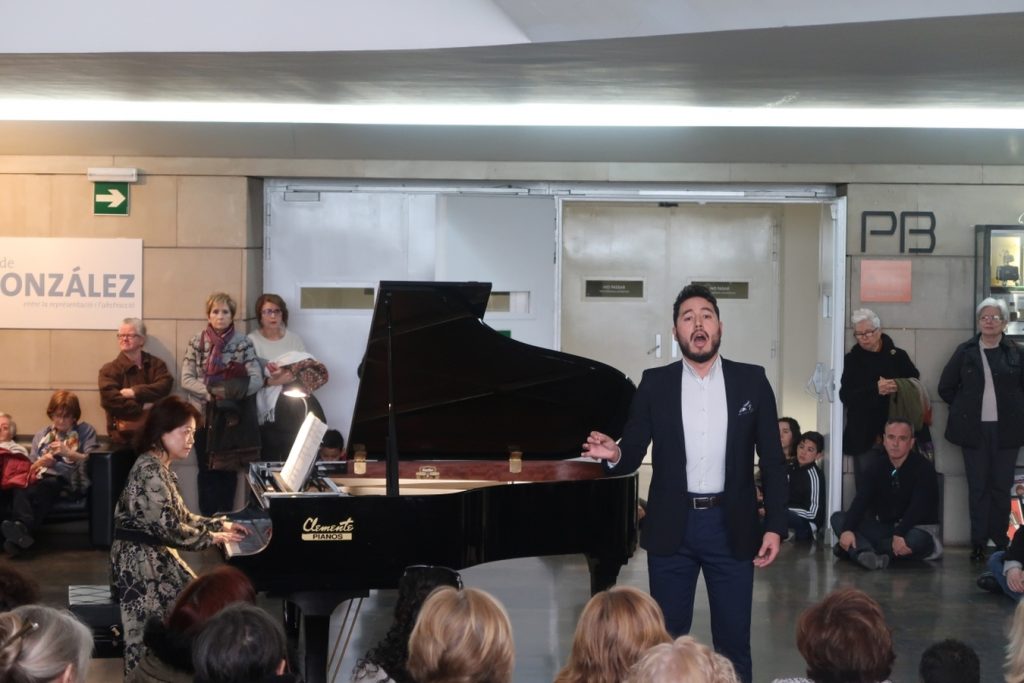
In 2020–2021 the IVAM and the  Advanced Study Centre (Palau de les Arts Reina Sofía) are continuing the series of musical performances that began in 2015, offering one performance a month from October 2020 to June 2021.

The main aims of this collaboration between the IVAM and Les Arts are to stimulate mutual involvement in the programmes of the two institutions and to show the inexorable link between different arts. A further objective is to place the cultural image of the Valencian Community in a position of prestige and to underline the importance of culture in the development of contemporary societies.

Essays on Seediness. Readings of the Archive Miguel Benlloch

ExhibitionLibraryIVAM Centre Julio González

The exhibition Ensayos sobre lo cutre is based on the work of the performer, poet and political and cultural activist Miguel Benlloch (1954-2018). Hosted by archivomiguelbenlloch.net, this portal gathers the records of his actions, writing and collaborations that show a critical look at identity, a thought from the body and a writing in the form of action, photography, book, proclamation, speech or banner. The actions that Benlloch will carry out with his political and aesthetic activity, will become a singular space to read and understand the development of art and activism in Spain at the turn of the century, which has been placed at the center of the debate and questioning of binary and heterocentric categories.

In the early eighties, at the Communist Movement’s booth at the Corpus Christi festivities in Granada, Benlloch took part in the organization of Cutre Chou, a show of small performances where the presence of the anti-Franco movement was visible. Ensayos sobre lo cutre takes this experience as a moment of condensation of ways where to begin to rehearse with the body and the voice and where to turn the shabby (lo cutre) into a dissident tool of the norm and of contempt to the form.

Beyond the presentation of a series of works collected in his Archive, the exhibition opens its repertoire to continue sharing Benlloch’s work. Ensayos sobre lo cutre invites the artists Equipo re, Julio Jara, Guille Mongan, Álvaro Romero, María Salgado and Fran MM Cabeza de Vaca, to create/show works in correspondence with those of Miguel Benlloch, in order to generate new links and statements that favor the advancement of transgressive and political artistic proposals.

Essays on Seediness. Readings of the Miguel Benlloch Archive, open to visitors in Gallery 3, continues in the Library, where archivomiguelbenlloch.net is available for consultation along with other records of the activism, actions and writings that complete this survey of the bonds and collaborations fostered by the artist during his lifetime.

Action, image, writing and voice that will be, in his own words, “condensations, sums of objects that have been life, traces of lived life that have spoken from the body and that in their accumulation seek new combinations to understand again”.

Videos

ExhibitionIVAM Centre Julio González

The intention of this new exhibition on Ignacio Pinazo is to propose a new biopolitical focus on the part of his oeuvre made up of paintings and drawings that were largely produced by the artist for himself, and are therefore less academicist in their style and poetics.

This set of works is especially interesting because the artist was himself recognised by contemporaries as the proponent of a systematic artistic practice performed on and in open public spaces. These artistic practices of Pinazo’s relate directly to new ways of inhabiting public spaces, changes in the behaviour of groups and multitudes, and the relations set up in the cultural context of their production.

The result is an updated reading of this artist in which processes of dominion, occupation, bodily interaction and the establishment of collective habit by groups and multitudes would combine with imaginaries on health, hygiene, pleasure, energy and intersubjective communication, calling the established social order into question.

Videos

Performance of the students of the Advanced Study Centre (Centre de Perfeccionament del Palau de Les Arts)

MusicIVAM Centre Julio González

In 2020–2021 the IVAM and the  Advanced Study Centre (Palau de les Arts Reina Sofía) are continuing the series of musical performances that began in 2015, offering one performance a month from October 2020 to June 2021.

The main aims of this collaboration between the IVAM and Les Arts are to stimulate mutual involvement in the programmes of the two institutions and to show the inexorable link between different arts. A further objective is to place the cultural image of the Valencian Community in a position of prestige and to underline the importance of culture in the development of contemporary societies.

Registration: actividades@ivam.es

ConversationsIVAM Centre Julio González

Lecture by Victoria Pérez Royo on the occasion of the Case Study: “Glacial Decoy”, Robert Rauschenberg – Trisha Brown.

Victoria Pérez Royo is a performing arts researcher and professor of Aesthetics and Theory of the Arts in the Department of Philosophy (Universidad de Zaragoza), co-director of the Master in Performing Arts Practice and Visual Culture (Universidad de Castilla La Mancha, Museo Reina Sofía), has given seminars in university performing arts programs in Germany, Brazil, Chile, Costa Rica, Finland, Holland and Peru, among other countries. She is an Artea researcher and coordinator of various projects: studies on research in the arts.