01, 07, 08, 14, 15, 21, 22, 28 and 29 apr. 2018
IVAM Centre Julio González
share


01, 07, 08, 14, 15, 21, 22, 28 and 29 apr. 2018
IVAM Centre Julio González
share
Guided tours to exhibitions by Pilar Martínez, BA Art History and Verónica Francés, artist and BA Fine Arts
Visits:
Pilar Martínez
Sunday April 1st MIRÓ, order and disorder (at 11.00 am)
Verónica Francés
Saturday April 7th PLEASE COME BACK. The world as prision?
Sunday April 8th PLEASE COME BACK. The world as prision?
Verónica Francés
Saturday April 14th The birth of abstraction
Pilar Martínez
Sunday April 15th RÓDTXENKO
Verónica Francés
Saturday April 21st The birth of abstraction
Sunday April 22nd The birth of abstraction
Verónica Francés
Saturday April 28 Against the tide
Pilar Martínez
Sunday April 29th RÓDTXENKO

04 may. 2018
IVAM Centre Julio González
floor 2, G4
share
Guided tour to the exhibition “The birth of abstraction” with the artist Soledad Sevilla.
Free activity. Priority for Honorary Members and Friends of the IVAM.
Application must be made 15 minutes before the start of the tour at the counter in the IVAM entrance hall. Places limited (allocated by order of application).

03, 04, 10, 11, 24 and 25 mar. 2018
IVAM Centre Julio González
share
Guided tours to exhibitions by Pilar Martínez, BA Art History and Verónica Francés, artist and BA Fine Arts
Visits:
Verónica Francés
Saturday March 3rd PLEASE COME BACK. The world as prision?
Sunday March 4th PLEASE COME BACK. The world as prision?
Verónica Francés
Saturday March 10th The birth of abstraction
Pilar Martínez
Sunday March 11th MIRÓ, order and disorder (at 11.00 am)
Verónica Francés
Saturday March 24th The birth of abstraction
Pilar Martínez
Sunday March 11th MIRÓ, order and disorder (at 11.00 am)

16 feb. 2018
IVAM Centre Julio González
share
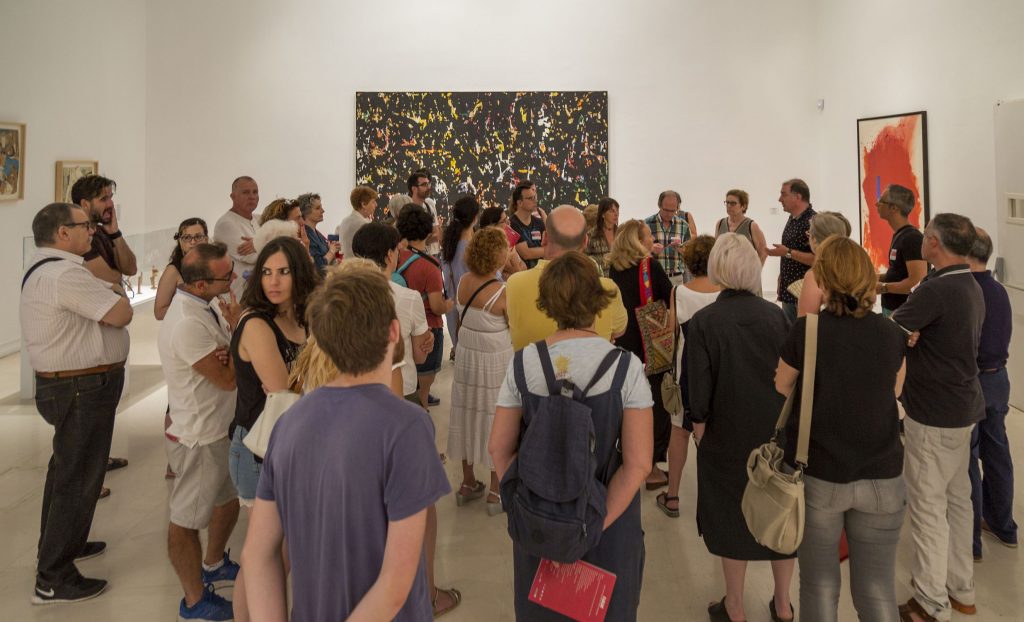
Conversation between Marko Daniel, Director of the Fundació Miró in Barcelona, and Joan Minguet, curator of the exhibition “Joan Miró, order and disorder”.
Joan Miró’s work lives on and continues to question the present age. It is one of the landmarks of the early avant-gardes of the 20th century that refuses to be relegated to the mausoleum of art history, a place where creation loses all possibilities of conflict. The exhibition Joan Miró, order and disorder explores the traces of indiscipline left by the artist in the course of his career. From the very outset, discipline and the process of learning were a kind of captivity from which he began to free himself when he arrived in Paris.
From then on, Miró moved along a strange path in which artistic and cultural order were always questioned. His paintings became a permanent conflict that exploded between 1969 and 1973; his characters engaged in a fight between reality and representation; and his work expanded towards society with his prolific production of public art, posters understood as urban graffiti and his participation in Morí el Merma, a theatrical celebration of the death of the dictator.
11, 24 and 25 feb. 2018
IVAM Centre Julio González
share
Guided tours to exhibitions by
Pilar Martínez, BA Art History
Verónica Francés, artist and BA Fine Arts
Visits:
February 11th, Please come back. The world as prision?, guided by Pilar Martínez
February 24th, The birth of abstraction, guided by Verónica Francés
February 25th, The birth of abstraction, guided by Pilar Martínez

11 jan. 2018
IVAM Centre Julio González
share
Lecture “El futuro, frustrado: Perspectivas sobre la infancia queer” by Alberto Mira, organized by the Chair of Artistic Studies. 20th / 21st centuries
Alberto Mira
Born in Alzira (Valencia) I studied English and Spanish Philology at the University of Valencia. Worked on an MA on gay theatre which sparked an interest on gay history and queer aesthetics and was followed up by a PhD dissertation on the queer aspects of the theatrical voices of Tennessee Williams and Joe Orton.
Spent two years as language assistant at Oxford University (Taylor Institution, 1989 – 1991) and a year as lecturer at Universitat Jaume I (1991 – 1992) in Castelló (Spain). In 1993 I returned to the United Kingdom where I have held a number of posts: between 1992 and 1995, I lectured in Spanish film, language and literature at Oxford University, in 1995 my first full time lecturing position at Middlesex University, where I taught several courses on language, literature and translation. In 1997 I became Queen Sofia Research Fellow at Exeter College, Oxford. In October 1999 I started my current job as a Reader at Oxford Brookes University.
I started at the Spanish department, and then was transferred to Film Studies in 2005. I was awarded sabbatical leave with the support of AHRC grants in 2002 and 2006, which allowed me two write my main monographs on gay cultures in Spain and on queer cinema. Since 2003 I published fiction, translation, academic and reference volumes, as well as articles on authors such as Terenci Moix, Pedro Almodóvar, Eduardo Mendicutti, Iván Zulueta, Mario Casas, Eduardo Blanco Amor, Manuel Puig, Federico García Lorca and other authors. Currently I am a member of the HERA funded project Crusev (“Cruising the Seventies”) and am preparing projects on pop musicals, and queer boyhoods.
CHAIR OF ARTISTIC STUDIES. 20th/21st CENTURIES
IVAM-UV-UPV (Institut Valencià d’Art Modern-Universitat de València-Universitat Politècnica de València-Universidad Miguel Hernández)
Directors: Juan Vicente Aliaga / Vicente Sánchez-Biosca
The life in images of contemporary culture outruns the (material and immaterial) traditional spaces in which they were entrapped in the past, even the recent past. Their genres and registers, their ambits of circulation, their ceaseless migrations give the impression of offering a previously unknown experience of the real at the same time as, in an apparent paradox, they display a not in the least feigned technological pride.
Nevertheless, however much studies of the History of Art, Fine Arts, Journalism and Audiovisual Communication have attempted to adapt to the demands of this state of affairs, the lability of the borders between creation and reflection, technology and art, the media and the collective imaginary, among others, requires more ductile ambits of reflection and debate than those to be found in university studies and traditional research. On the other hand, unlike classical philology, palaeography, the exegesis of written texts and the image still presents an imbalance between its (emotional, conceptual, political, memory-based) impact and the instruments provided to analyse it.
The aim of Cátedra Estudios Artísticos, arising from the collaboration between the University of Valencia, the Polytechnic University of Valencia and the IVAM, will consist in encouraging this reflection about the life of images both in the world of art and in social life, including imaginary. It will do so broadmindedly, avoiding academic, artistic or technological restrictions, but, nevertheless, thriving on and taking advantage of all the academic, museum-based and institutional aids at its disposal. For that reason, the fact that it is held at the IVAM is propitious because it can enrich its activities with the reflection about exhibitions, installations or lectures, and also the series of projections.
04 dec. 2017
IVAM Centre Julio González
share
Lecture by the French historian Henry Rousso, organized by the Chair of Artistic Studies. 20th / 21st centuries
Henry Rousso, is an Egyptian-born French historian specializing in World War II France.
CHAIR OF ARTISTIC STUDIES. 20th/21st CENTURIES
IVAM-UV-UPV (Institut Valencià d’Art Modern-Universitat de València-Universitat Politècnica de València-Universidad Miguel Hernández)
Directors: Juan Vicente Aliaga / Vicente Sánchez-Biosca
The life in images of contemporary culture outruns the (material and immaterial) traditional spaces in which they were entrapped in the past, even the recent past. Their genres and registers, their ambits of circulation, their ceaseless migrations give the impression of offering a previously unknown experience of the real at the same time as, in an apparent paradox, they display a not in the least feigned technological pride.
Nevertheless, however much studies of the History of Art, Fine Arts, Journalism and Audiovisual Communication have attempted to adapt to the demands of this state of affairs, the lability of the borders between creation and reflection, technology and art, the media and the collective imaginary, among others, requires more ductile ambits of reflection and debate than those to be found in university studies and traditional research. On the other hand, unlike classical philology, palaeography, the exegesis of written texts and the image still presents an imbalance between its (emotional, conceptual, political, memory-based) impact and the instruments provided to analyse it.
The aim of Cátedra Estudios Artísticos, arising from the collaboration between the University of Valencia, the Polytechnic University of Valencia and the IVAM, will consist in encouraging this reflection about the life of images both in the world of art and in social life, including imaginary. It will do so broadmindedly, avoiding academic, artistic or technological restrictions, but, nevertheless, thriving on and taking advantage of all the academic, museum-based and institutional aids at its disposal. For that reason, the fact that it is held at the IVAM is propitious because it can enrich its activities with the reflection about exhibitions, installations or lectures, and also the series of projections.

12 and 26 mar. 2017
IVAM Centre Julio González
floor 2, G6
share
Guided tours to exhibitions by Pilar Martínez, BA Art History.
Visits:
Fake. It is not true, it is not a lie
January 8th and 22nd
Case study: RICHARD HAMILTON. Objects, interiors, self-portraits and people.
February 12th and 26th
Xavier Arenós. Presence and absence.
March 12th and 26th
*** THIS VISITS WILL BE IN SPANISH***

02 and 09 apr. 2017
IVAM Centre Julio González
floor B, G2
share
Guided tours to exhibitions by Pilar Martínez, BA Art History.
Visits:
Fake. It is not true, it is not a lie
January 8th and 22nd
Case study: RICHARD HAMILTON. Objects, interiors, self-portraits and people.
February 12th and 26th
Xavier Arenós. Presence and absence.
March 12th and 26th
Las constelaciones de Julio González.
April 2nd and 9th
*** THIS VISITS WILL BE IN SPANISH***

07 and 21 may. 2017
IVAM Centre Julio González
floor 2, G7
share
Guided tours to exhibitions by Pilar Martínez, BA Art History.
Visits:
Fake. It is not true, it is not a lie
January 8th and 22nd
Case study: RICHARD HAMILTON. Objects, interiors, self-portraits and people.
February 12th and 26th
Xavier Arenós. Presence and absence.
March 12th and 26th
Las constelaciones de Julio González.
April 2nd and 9th
Helena Almeida. Corpus.
May 7th and 21st
*** THIS VISITS WILL BE IN SPANISH***
17 and 24 sep. 2017
IVAM Centre Julio González
share
Guided tours to exhibitions by Pilar Martínez, BA Art History.
Visits:
Fake. It is not true, it is not a lie
January 8th and 22nd
Case study: RICHARD HAMILTON. Objects, interiors, self-portraits and people.
February 12th and 26th
Xavier Arenós. Presence and absence.
March 12th and 26th
Las constelaciones de Julio González.
April 2nd and 9th
Helena Almeida. Corpus.
May 7th and 21st
Joana Hadjithomas & Khalil Joreige.
June 11th and 25th
Carmela García. Images of power – cartography of the invisible
September 17th
Case study: Robert Frank
September 24th
*** THIS VISITS WILL BE IN SPANISH***

08 and 22 oct. 2017
IVAM Centre Julio González
floor 2, G7
share
Guided tours to exhibitions by Pilar Martínez, BA Art History.
Visits:
Fake. It is not true, it is not a lie
January 8th and 22nd
Case study: RICHARD HAMILTON. Objects, interiors, self-portraits and people.
February 12th and 26th
Xavier Arenós. Presence and absence.
March 12th and 26th
Las constelaciones de Julio González.
April 2nd and 9th
Helena Almeida. Corpus.
May 7th and 21st
Joana Hadjithomas & Khalil Joreige.
June 11th and 25th
Carmela García. Images of power – cartography of the invisible
September 17th
Case study: Robert Frank
September 24th
Anzo. Isolation
October 8th and 22nd
*** THIS VISITS WILL BE IN SPANISH***