Robert Rauschenberg – Trisha Brown

Case studyExhibitionIVAM Centre Julio González

Trisha Brown’s choreography Glacial Decoy was previewed on 7 May 1979 at the Children’s Theater in Minneapolis (Minnesota). For the dancer, choreographer and artist (Aberdeen, Washington, 1936-San Antonio, Texas, 2017), Glacial Decoy was a turning point in her career, as it was her first work conceived for the proscenium stage, following others made for alternative spaces. For this change of presentation venue, Trisha Brown brought on board the artist Robert Rauschenberg (Port Arthur, Texas, 1925-Captiva Island, Florida, 2008), who she had met at Merce Cunningham’s studio in the early sixties and who had prior experience working with choreographers like Cunningham, Paul Taylor, Viola Farber and with the Judson Dance Theater.

This Case Study relates five works by Robert Rauschenberg from the IVAM collection, Glacial Decoy Series I-V (1979), with Trisha Brown’s choreography, for which Rauschenberg designed sets, lighting and costumes. The images in these photoetchings come from the surroundings of Fort Myers in Florida, and are part of the 620 that Rauschenberg chose, from a total of over 6000, for the visual presentation of Glacial Decoy.

Trisha Brown and Robert Rauschenberg played a key role in the development of postmodern dance, pushing the envelope of form and movement. Their joint work proved critical for their individual visu-al and kinetic research, and over the course of five decades Brown and Rauschenberg had a profound influence on each another.


Videos

Performance of the students of the Advanced Study Centre (Centre de Perfeccionament del Palau de Les Arts)

MusicIVAM Centre Julio González

In 2020–2021 the IVAM and the  Advanced Study Centre (Palau de les Arts Reina Sofía) are continuing the series of musical performances that began in 2015, offering one performance a month from October 2020 to June 2021.

The main aims of this collaboration between the IVAM and Les Arts are to stimulate mutual involvement in the programmes of the two institutions and to show the inexorable link between different arts. A further objective is to place the cultural image of the Valencian Community in a position of prestige and to underline the importance of culture in the development of contemporary societies.

Streaming on the IVAM Youtube channel


ConversationsIVAM Centre Julio González

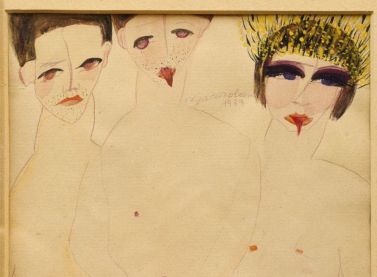
Lecture on the occasion of the opening of the exhibition “MORAL DIS/ORDER. Art and sexuality in Europe between the wars” by the curator Juan Vicente Aliaga.

‘This exhibition will examine the changes that took place in sexuality and morality in Europe in the period between the two world wars. During that time, one can observe the impact of conservatism on laws and the persistence of religious mores. At the same time, it is imperative to bear in mind the aftereffects of the Great War on the general population. The social crisis in which European societies were caught up and the fierce zest for life following such a dark period prompted the rise of forms of behaviour in individuals and groups that diverged from the dominant order. This newfound freedom in customs found a fertile terrain for expression in art. The use of photography facilitated the exposure of the body and nudity but other mediums—drawing, printing, painting, sculpture—were also used to capture this nonconformity with the moralizing norm. These expressions of freedom flourished more often in big cities like Berlin and Paris. That being said, censorship continued to be exercised and ongoing social and legal control was reflected in all kinds of repressive situations. The rise to power of Fascism and totalitarianism (Germany, Italy, Spain, Soviet Union) brought an end to this vision of a new society.’ J.V. Aliaga.

The exhibition includes over 180 artworks divided into seven sections: Cultures of the Body; The Bloomsbury Group and Other Aesthetics; Trauma and Desire; Under this Mask, Another Mask (Sous ce masque, un autre masque); The Depths of Sex; Salacious Times and Virile Totalitarianisms, featuring a range of drawings, paintings, prints, photographs, sculptures and films by more than 45 artists such as Hans Bellmer, Romaine Brooks, Brassaï, Federico García Lorca, Gluck, Duncan Grant, Hannah Höch, Tamara de Lempicka, Maruja Mallo, Jeanne Mammen, Néstor, Max Pechstein, Gregorio Prieto, Carol Rama, Rudolf Schlichter, Sascha Schneider, Suzanne Valadon, Ethel Walker and Gerda Wegener, as well as a selection of books, journals and other documentation from the period.

Walks through works of the museum collection view from the genre perspective

AccessibilityRecursosIVAM Centre Julio González

For more information, please check the Spanish version.

48 publications

IVAM ProduceLibraryIVAM Centre Julio González

48 publicaciones is the name I’ve given to a study of the contemporary art library a friend of mine has at home to which he has generously given me access. One day I told him that I would like to make a selection of his art books for a suite of paintings reproducing their covers and some pencil drawings of aspects related to their content.

The starting point for the selection was the sixties and artists like Ed Ruscha and the Fluxus group who treated the artist’s book as an artwork in its own right. These were followed by publications by conceptual artists, photo-books, poetry collections and other texts published up until the present day. I should also clarify that the selection is purely subjective on my behalf and has no pretensions to establish any kind of historical continuity. I was guided more by certain affinities, and I did not include some very beautiful catalogues of paintings that were highly influential for my own practice because they were outside the initial remit; paintings are much more eloquent on walls than in reproductions in books. Paradoxically, I have taken to painting and drawing techniques that, as I said earlier, I use for the reproductions, an art in principle more removed from them. Not so much from drawing …

My hope is that the collection of book covers, 48 in total, will function like a field, perhaps disperse and even with subgroups but nevertheless one single field. The form of exhibiting it will depend on the space where it will be shown. It has occurred to me that, given the impossibility of showing the collection of drawings physically, because of their sheer number, they could be shown in a slide projection, one by one, in this way taking on the quality of a document and archive.

I am also considering the idea of accompanying the two collections with a couple of display cases showing the making-of of each one.

ExhibitionIVAM Centre Julio González

The What is Our Home? exhibition grew out of an interest in striking up a dialogue, in forging a connection and affinity between the collections of IVAM and of MAXXI, Rome. With this goal in mind, we have brought together a group of works from the collection of the Italian museum (Ilya & Emilia Kabakov, Francis Alys, Jana Sterbak, Mario Merz, Alfredo Jaar, Kara Walker, William Kentridge, Atelier Van Lieshout and Teddy Cruz) with some major works from the IVAM collection (Bruce Nauman, Gabriele Basilico and Richard Hamilton). Their common ground is a concern with the inhabited and social space, a questioning of the city, the home, the community, or the personal sanctuary.

The exhibition seeks to understand how spaces mark time and are linked to a place’s memory. We present a group of works and large installations that seem to be an accumulation of places with varying degrees of closeness and disconnectedness, and which draw attention to the fragmentation of the human experience, to the inability to comprehend the social whole and to the imperfection of knowledge.

In addition, What is Our Home? wishes to talk about those people who feel like strangers no matter where they are, as they come to feel that their existence unfolds, somewhat anxiously, in cities that they no longer recognize and in urban spaces in which they have no place or space. And so, in the exhibition we find a group of ideas and projects that understand architecture as a structure that condenses a physical world; as the desire to build a place (a haven, a sanctuary, a house, a home…) defined by the people that use it, as if it were a (more or less free) version of ourselves.

Videos

Art and sexuality in Europe between the wars

ExhibitionIVAM Centre Julio González

‘This exhibition will examine the changes that took place in sexuality and morality in Europe in the period between the two world wars. During that time, one can observe the impact of conservatism on laws and the persistence of religious mores. At the same time, it is imperative to bear in mind the aftereffects of the Great War on the general population. The social crisis in which European societies were caught up and the fierce zest for life following such a dark period prompted the rise of forms of behaviour in individuals and groups that diverged from the dominant order. This newfound freedom in customs found a fertile terrain for expression in art. The use of photography facilitated the exposure of the body and nudity but other mediums—drawing, printing, painting, sculpture—were also used to capture this nonconformity with the moralizing norm. These expressions of freedom flourished more often in big cities like Berlin and Paris. That being said, censorship continued to be exercised and ongoing social and legal control was reflected in all kinds of repressive situations. The rise to power of Fascism and totalitarianism (Germany, Italy, Spain, Soviet Union) brought an end to this vision of a new society.’ J.V. Aliaga.

The exhibition includes over 180 artworks divided into seven sections: Cultures of the Body; The Bloomsbury Group and Other Aesthetics; Trauma and Desire; Under this Mask, Another Mask (Sous ce masque, un autre masque); The Depths of Sex; Salacious Times and Virile Totalitarianisms, featuring a range of drawings, paintings, prints, photographs, sculptures and films by more than 45 artists such as Hans Bellmer, Romaine Brooks, Brassaï, Federico García Lorca, Gluck, Duncan Grant, Hannah Höch, Tamara de Lempicka, Maruja Mallo, Jeanne Mammen, Néstor, Max Pechstein, Gregorio Prieto, Carol Rama, Rudolf Schlichter, Sascha Schneider, Suzanne Valadon, Ethel Walker and Gerda Wegener, as well as a selection of books, journals and other documentation from the period.

Warning: sexually explicit images

Videos

ExhibitionIVAM Centre Julio González

This is the first major solo show by Gülsün Karamustafa (Ankara, 1946) in Spain. And an excellent opportunity to familiarize ourselves with the work of arguably the most internationally acclaimed living Turkish artist and one of the most unique voices in contemporary art.

It would be nigh on impossible to understand her work unless we take into account what the city of Istanbul means both for her personal life and her art practice. Istanbul, not just for Turkey but also for the rest of the world, is much more than a metropolis at the crossroads between Asia and Europe, between the East and the East: one might even say that Istanbul is a world in itself.

Historically, Istanbul has always been a cosmopolitan city with a vast cultural and religious wealth; a geographic melting pot that makes it the true antithesis of homogenous culture. The coexistence and exchanges between the many highly different communities in the city have guaranteed the survival of its cultural legacy.

And Gülsün Karamustafa’s practice is solidly grounded in its culture and people, while at once looking outwards to the wider world, making her an artist fully engaged and committed with her time, keenly interested in pushing the envelope of concepts, materials, ideas and artistic spaces. She straddles two worlds (that have often turned their backs on one another) in order to offer us the best of both. She is a key artist in understanding that is no longer possible to conceive human life based on a world of irreconcilable opposites.

As one can see in this exhibition, in her work, Karamustafa teaches us how to open our minds, to be freer, to value those things that often elude us because we are blinded by stereotypes. Her works are like an open window on a virtually unknown world of great wealth.

Videos

ConversationsIVAM Centre Julio González

On the occasion of the International Museum Day the IVAM presents, through its Youtube channel, a conversation between Nuria Enguita, Director of Bombas Gens Centre d’Art and José Miguel G. Cortés, Director of the IVAM, about “Museums after the pandemic”.

Connection through the IVAM Youtube Channel

IVAM reopens with the usual schedule. Free admission until the end of the year

OthersIVAM Centre Julio González

Dark Man a lomos del Pájaro de Fuego

IVAM ProduceIVAM Centre Julio González

The starting point for the specific project carried out by Jorge Peris (Alzira, 1969) was his return in 2011 to Valencia, the city where he began his training as an artist. Specifically, he went back to El Palmar, which involved meeting memories, but also the landscape of the Albufera and all its surroundings.

In Gallery 6 Jorge Peris constructs an unusual inhabited place with an installation that plays with the exhibition area, with its diagonals and columns and its staircase. He materialises his imagery, constructing it with characters that are revealed as visitors make their way through the exhibition and that take on various forms, overlapping times and places in a single dimension.

Videos

Performance of the students of the Advanced Study Centre (Centre de Perfeccionament del Palau de Les Arts)

MusicIVAM Centre Julio González

In 2019–2020 the IVAM and the  Advanced Study Centre (Palau de les Arts Reina Sofía) are continuing the series of musical performances that began in 2015, offering one performance a month from October 2019 to June 2020.

The main aims of this collaboration between the IVAM and Les Arts are to stimulate mutual involvement in the programmes of the two institutions and to show the inexorable link between different arts. A further objective is to place the cultural image of the Valencian Community in a position of prestige and to underline the importance of culture in the development of contemporary societies.

RESERVATION CLOSED